
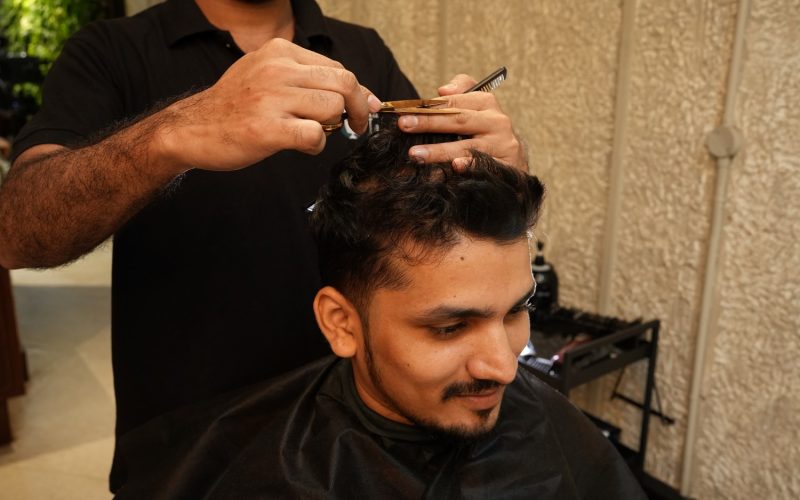
Nobody schedules a haircut at exactly the right time. It is either too soon, the cut barely needs touching up, or too late, the shape is gone and the barber has to work backwards before he can move forward.
Most men figure out a rough cadence through trial and error. Go too late and the haircut stops looking like a haircut. Go too often and you are spending money on appointments that did not need to happen yet. Somewhere in the middle is the right answer, and where exactly that sits depends almost entirely on what is happening on top of your head right now.
Same question, very different answers
Ask ten men how often they get a haircut and you will get ten different answers. Some go every two weeks. Some stretch to eight. Both can be right depending on the cut.
Haircut frequency for men is not a universal number. A buzz cut and a longer textured style do not age at the same rate. A high skin fade and a low taper are not on the same schedule. The cut is what determines the cadence, not some general rule about what men are supposed to do.
Short, precise cuts with tight lines need more frequent visits because precision is what makes them work and precision is the first thing to go when the hair starts growing. Longer, looser styles have more room to breathe. The shape holds for longer before it collapses into something unintentional.
Getting a fade haircut specifically puts you on a shorter leash than most men expect when they first start getting them. That is not a complaint, just a practical reality worth knowing upfront.
The fade question
How long does a fade last is probably the most searched version of this question, and the answer is less satisfying than most people want it to be: it depends.
High skin fade, sides taken all the way down to skin. That starts losing its sharpness within a week. By two weeks, the regrowth is visible enough to soften the gradient noticeably. In three weeks, it will be a different haircut. Men who want that level of contrast maintained properly are looking at every two to three weeks, which sounds frequent until you see what a high fade looks like at week four and understand why.
Mid fade sits lower on the head and the regrowth is less immediately obvious. Three to four weeks is usually workable. The gradient softens but does not disappear as quickly.
Taper fade is the most forgiving. It sits close to the natural hairline and the transition is subtle enough that the growth blends in gradually rather than obviously undoing the cut. Four weeks between visits is often fine here, sometimes a little longer depending on how fast the hair grows.
The hair type variable
Two men can walk out of the same chair with the same haircut and need to come back at completely different times. Hair type is the reason behind this.
Thick, coarse hair adds visible volume fast. A fade fills in within two weeks in a way that fine hair simply does not. A short cut on thick hair goes from sharp to dense fairly quickly, and dense is not the same as sharp. Men with thicker hair generally need to come in more often just to maintain the same level of precision.
Fine hair grows at the same biological rate but the change shows up differently. The sides do not bulk out the way thick hair does. A fade on fine hair tends to hold its look for slightly longer before the regrowth becomes the main character.
Curly hair operates on its own logic. The curl pattern can mask growth for the first week or two and then suddenly the shape is completely different. Men with curly hair often find the ideal time to book is just before that shift happens, which takes a few appointments to identify but becomes obvious once you have seen it a couple of times.
What waiting too long actually does
There is a version of every haircut that exists for a window of time. Outside that window, it is just hair at various lengths doing its own thing.
For a fade, the window closes faster than most men expect. The gradient disappears as the sides grow in. The contrast that made the whole thing work is gone. What is left is not necessarily a bad look, just a formless one. The structure has gone without anything replacing it.
For longer cuts, the collapse is more gradual. A crop that was sitting flat starts gaining weight. A textured style stops looking textured and starts looking overgrown. The cut is still technically there somewhere underneath the growth but it has stopped doing its job.
The other practical issue with waiting too long is what it does to the next appointment. Instead of a maintenance visit that keeps the look on track, it becomes a reset. The barber has to take off more than intended, spend longer getting back to the baseline, and the result is an appointment that costs the same but delivers less of what was wanted.
Rough guide based on cuts
Two to three weeks: high skin fades, buzz cuts, crew cuts. Anything where precision lines are the whole point. These do not survive long between visits.
Three to four weeks: mid fades, low fades, taper fades, short crops. Enough length and structure to hold for a bit longer before the regrowth starts telling its own story.
Four to six weeks: longer styles, looser textured cuts, anything where the shape does not depend on tight gradients. More forgiving, more room to stretch the gap without visible consequences.
These are starting points. Hair growth rate varies person to person and some men’s hair genuinely grow faster than average, which shifts all of this earlier regardless of the cut.
The barber relationship
General guides on haircut frequency for men can only go so far. The most accurate answer to how often you should be coming in is the one your barber gives you after a few appointments together.
Someone who has seen your hair grow across several visits knows your growth rate, knows how the cut ages on your specific head, and can tell you when to come back with better precision. That ongoing familiarity is part of what makes a regular barber worth having rather than just booking whoever has availability.
If you are looking for a mens haircut in Khar, The Lair Man is worth making that regular spot. Whether it is figuring out how often to get a fade haircut that stays sharp or working out the right schedule for a longer style, the answer gets clearer the more consistent the relationship is.
What Suits You
Fade haircuts, especially high ones, every two to three weeks. Mid and low fades, three to four. Longer styles, four to six. When genuinely unsure, look at the cut and ask whether it still looks like what you walked out with. If it does, wait. If it does not, book.
The right cadence is the one that keeps the cut looking like the cut.