Getting a fade can become a mundane experience if you don’t know much about them. Here’s how the typical experience goes:
You walk in, the barber asks low, mid, or taper, and you just pick one. Maybe you saw it on someone. Maybe you pointed at your phone. Maybe you said “whatever suits me” and hoped the guy behind the chair knew better than you did. Sometimes it works out great. Sometimes you spend the next month growing out a haircut that looked nothing like what you had in mind.
Here is the thing. A fade haircut for men is not one thing. Low, mid, taper, they each do something different to your face, and once you understand what that is, the choice becomes a lot less of a coin flip.
What Even Separates Them
All three are fades. Hair goes from longer on top to short on the sides, blending gradually rather than stopping at a hard line. No shelf, no visible steps. Just a clean drop.
The only real difference is where on the head that drop starts. That one variable changes the entire silhouette, and by extension, how your face reads to everyone looking at you.
Low Fade
A low fade haircut starts near the bottom of the head, just above the ears and the neckline. The sides stay relatively full because the fade only happens in that lower strip. The overall shape of your head stays largely intact.
This is the subtler option. Less drama, more refinement.
Men with longer or narrower faces tend to do well with a low fade. Cutting the sides down aggressively on a long face tends to make it look even longer, so keeping that fullness lower helps. The proportions stay balanced without the cut doing anything too aggressive.
Round faces can wear a low fade too, though it probably works better when there is something happening on top to add some height. Without that, a low fade on a rounder face can sometimes just sit there without doing much for the shape.
Mid Fade
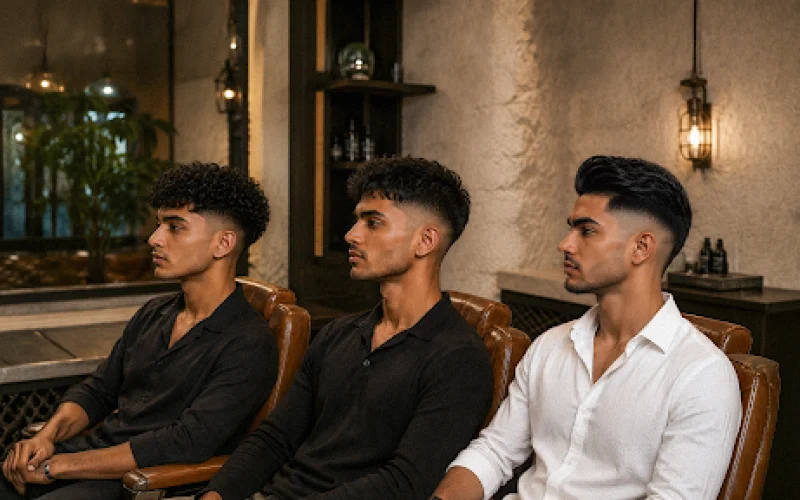
The mid fade haircut kicks in around the temples, about halfway up the sides. This is where contrast enters the picture. The difference between the shorter sides and whatever length is on top becomes visible and intentional. The whole cut reads sharper.
Honestly, if there is a default setting for a fade haircut for men, this is probably it. It sits at a neutral point on the head. Not so low that it disappears quietly into the neckline, not so high that it completely transforms the silhouette. Most face shapes handle it without any real issue.
Oval faces pair well with a mid fade almost regardless of what is going on top. Square faces tend to find that the contrast actually works with the jaw rather than fighting it. Round faces arguably get the most out of a mid fade because it introduces some vertical structure. The eye travels upward. The face reads as slightly longer than it is.
If someone does not know where to start, a mid fade is likely the sensible answer. It leaves room to move in either direction once you figure out what actually works for you.
Taper Fade
The taper fade is where people start getting confused, partly because barbers use taper and fade as if they mean the same thing, which they do not, not exactly.
A taper is a gradual reduction in hair length that stays close to the natural hairline. Around the ears, around the neckline. The hair gets shorter toward the edges but does not necessarily go all the way to the skin. A taper fade combines both things: the gradual drop of a taper with the clean skin-close finish of a fade, usually kept low and tight rather than climbing high up the sides.
The taper fade haircut tends to suit men who want something polished without the high-contrast look of an aggressive skin fade. Men with longer face shapes generally do well with it because it does not add unnecessary width or height. It also handles thicker hair reasonably well since it manages the bulk without exposing too much scalp.
In professional environments especially, a taper fade reads as clean and put-together. Not edgy, not loud. Just sharp. That is a hard balance to hit with some of the more dramatic variations.
Which Fade Actually Suits Your Face
There is no universal best fade haircut for face shape. But some patterns hold up consistently enough to be worth knowing.
Oval faces have the most flexibility. Almost any fade works. Spend more energy thinking about your hair texture and how much upkeep you actually want than trying to optimise for a face shape that already works with most cuts.
Round faces tend to benefit from contrast and vertical line. A mid fade with some height on top pulls the eye upward, which creates the impression of more length. A low fade on its own tends to do the opposite, making things look wider rather than longer.
Square faces suit fades that let the jaw do what it does naturally. Mid or low fades work well here. Very high skin fades can sometimes make a square face look harder than it needs to.
Long or narrow faces do better with lower fades that preserve some width on the sides. A low fade or taper fade, paired with a style that adds volume outward rather than upward, helps balance the proportions.
Diamond faces, wider at the cheekbones and narrower at both the forehead and jaw, appear to suit taper fades and low fades well. Keeping extra width off the sides is generally a good direction.
If you are in Mumbai and looking for a barber shop that will think about your face and your hair before deciding anything, The Lair Man in Khar West is worth checking out. That kind of attention is rarer than it should be, and it shows in the result.
What Actually Makes the Difference
Face shape gets most of the attention in these conversations, and it matters. But hair texture is probably just as important and gets ignored far too often.
A mid fade on thick, dense hair looks completely different from a mid fade on fine hair, even on identical face shapes. The weight of the hair changes how the fade sits, how sharp the blend reads, and how long the whole thing holds before needing a touch-up. A good barber factors both into what they do, and that conversation before the cut starts is usually what separates something that genuinely works from something that only sort of does.